Sales
Tracks quotations, customers and orders.

OCTO · Ready solutions
Octo connects product definitions, sales orders, purchasing, production planning, quality checks and shipment in one shared structure. Teams work with the same data and follow order status, material requirements and production progress together.
EVERYDAY USE
We can adapt this example flow to your responsibilities and record structure.
Define products so sales and production use the same components, variants and operation records.
Pass sales orders to planning. Delivery dates and quantities inform production requirements and priorities.
Compare stock with material needs. Link shortages to purchasing and planned work to work orders.
Record production progress and quality checks. Follow the history of the product, work and order together. Quality Management →
Match goods ready for delivery to shipments. Sales and warehouse teams see the order stage from the same data.
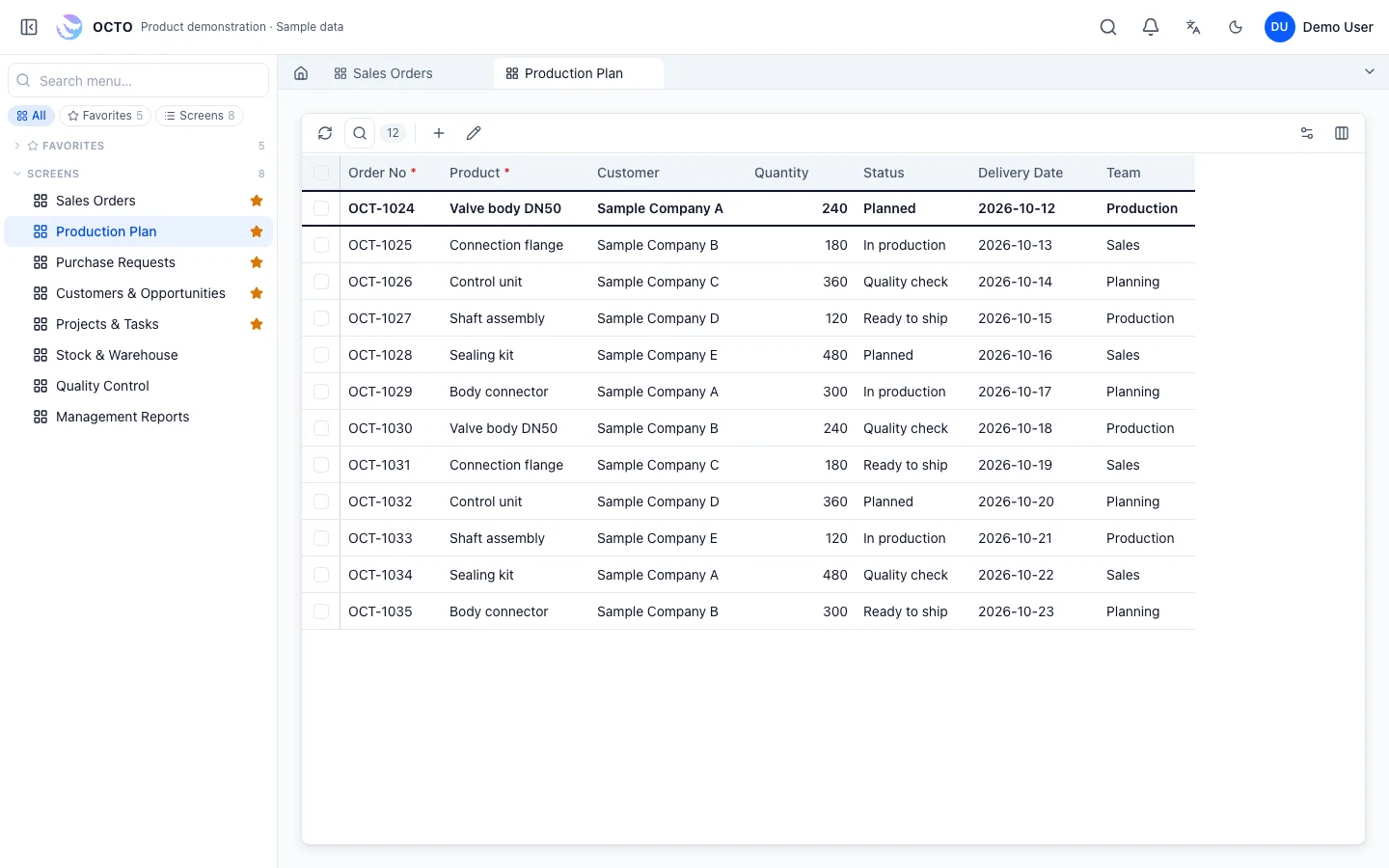
OCTO interface · sample data
Example responsibilities; access is configured during implementation.
Tracks quotations, customers and orders.
Works with material requirements, work orders, operations and production records.
Reviews stock movements, shipments and management reports.
Changes are assessed for their effect on data, permissions and existing records, then deployed after testing and user review.
Track quotation totals, currency, payment terms and product prices alongside order information. Review costs and management reports with production, stock and shipment data. Data exchange with your existing accounting software is agreed within the project based on available connectivity.
Integration approach →Sales, purchasing, stock, production, quality and shipment scope is agreed during analysis. Screens and custom adaptations are recorded in your proposal.
We assess working with your existing accounting software. Supported products and versions, fields and transfer direction are agreed separately.
Orders arrive in planning with due dates and quantities; the planner sees stock and capacity and creates work orders. When the plan changes, work orders and material needs update together.
Product, customer, supplier and stock lists are prepared and imported together during the project. Connections to accounting or other systems are assessed separately.
It depends on scope. The Akron Tekstil project went live in 60 days; your timeline is set in the proposal together with scope and data readiness.
RELATED TOPICS
OCTO ERP and Manufacturing Management brings production planning, work orders, product trees, stock, purchasing and shipment into one record structure. The topics below match what manufacturers ask for most.
Sales, purchasing, stock, production, quality and shipment on one platform; the screens you use are agreed during analysis.
Work orders, operations and production records in a shared structure; progress from the shop floor, reports on a management board.
Job sequence based on orders, due dates, stock and capacity; shortages become purchase requests, planned work becomes work orders.
See which operation, machine and person a work order is with; output, scrap and downtime go onto the same record.
Components, variants and operations; material needs per order and recipe revision history.
Batch, lot and serial numbers; trace back from shipped product to raw material and quality records.
Real product cost by material, labour, subcontracting and scrap; planned versus actual.
Requests, quotes, orders and goods receipt; supplier performance and incoming inspection on the same record.
Stock by location, batch and quantity; counts, transfers and movement records.
From order to delivery note; goods ready to ship, packing and shipment plan in one list.
Operators scan work orders in OCTO Mobile; output, scrap and quality entries happen at the line. OCTO Mobile →
Discovery, adaptation, training and go-live steps run with Renium consultants. Implementation and Launch →
ERP, manufacturing, customer management or a process unique to your business. Tell us what you need and let’s find the right starting point.